If you've spent any time online lately, you've heard about artificial intelligence. AI is suddenly everywhere. It writes essays, generates art, and helps drive our cars. But behind the buzzwords and the hype, what is artificial intelligence, exactly?
You don't need a computer science degree to understand it. At its core, AI is a set of technologies that allow computers to perform tasks that typically require human intelligence. Think of things like recognizing speech, making decisions, or translating languages.
We've moved past the days when AI was just a sci-fi trope. Today, it's a practical reality shaping how we work and live.
Stripping Away the Magic
People often talk about AI as if it's a thinking, feeling brain. It isn't. When we ask how AI works, we're really asking how a machine processes information.
Traditional computer programs follow rigid, step-by-step instructions. A human programmer writes the code, and the computer does exactly what it's told. If A happens, do B.
AI flips that model on its head. Instead of giving the computer exact instructions, we feed it massive amounts of data and let it find the patterns on its own.
Let's say you want a computer to recognize a picture of a cat. In the past, a programmer would try to write code describing a cat: pointy ears, whiskers, a tail. That never worked well because cats come in endless shapes and positions.
An AI system learns differently. You show it a million pictures of cats and a million pictures of things that aren't cats. Over time, the system figures out the underlying patterns that make a cat a cat. The more data it processes, the better it gets.
The Building Blocks: Machine Learning and Deep Learning
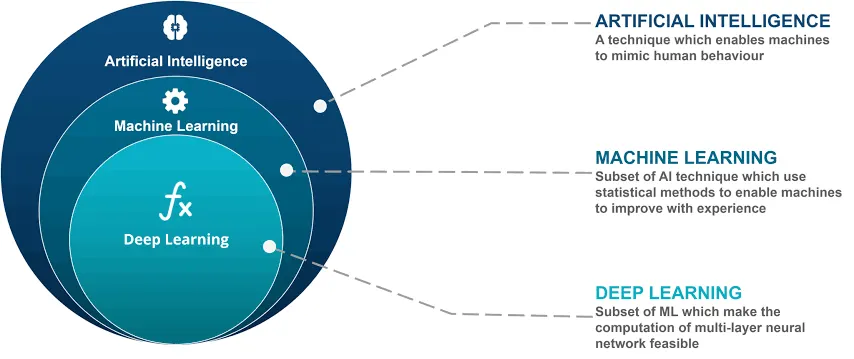
You'll often hear terms like "machine learning" and "deep learning" thrown around alongside AI. They aren't exactly synonyms. Think of them as nesting dolls.
Machine Learning
Machine learning is a subset of AI. It's the engine driving most of the AI we interact with daily. The core idea is that the system learns from data without being explicitly programmed for every single task.
When Netflix recommends a movie or your email filters out spam, that's machine learning at work. The algorithm looks at your past choices (or the characteristics of known spam) and makes a prediction.
Deep Learning
Deep learning is a subset of machine learning. It uses complex structures called artificial neural networks, inspired loosely by the human brain. These networks have multiple layers (hence "deep") that process data in increasingly abstract ways.
Deep learning is what powers the most advanced AI breakthroughs we see today, like voice assistants that actually understand context or self-driving cars navigating busy streets.
Curious about how these neural networks actually function under the hood?
The sheer processing power required for deep learning is massive. It's why startups are looking at nuclear power to run Nvidia's AI chips.
Narrow AI vs. General AI
When discussing what artificial intelligence is, we have to distinguish between what exists today and what might exist in the future.
Artificial Narrow Intelligence (ANI)
Everything we have right now is Narrow AI. These systems are incredibly good at specific tasks. The AI that beats grandmasters at chess is a marvel, but if you ask it to recommend a restaurant or drive a car, it's completely useless. It only knows chess.
Even impressive systems like ChatGPT are narrow. They are trained to predict the next logical word in a sentence based on massive text datasets. They don't actually understand the meaning of what they're saying. (This lack of true understanding is why companies are in a race to eliminate AI hallucinations, where the system confidently presents false information as fact).
Artificial General Intelligence (AGI)
This is the holy grail for researchers. AGI would be a system with cognitive abilities equal to a human. It could learn any intellectual task, reason abstractly, and adapt to completely new situations. We don't have AGI yet. Experts debate whether we're years, decades, or centuries away from it.
Comparing AI Types
Feature | Narrow AI (Today) | General AI (Future) |
Scope | One specific task or domain | Any intellectual task |
Adaptability | Rigid; fails outside its training | Highly adaptable |
Understanding | Pattern matching, no true comprehension | Human-like reasoning and logic |
Examples | Siri, self-driving cars, ChatGPT | None currently exist |
Why AI Is Taking Off Now
The concepts behind artificial intelligence aren't new. The term was coined back in 1956. So why the sudden explosion?
Three things came together at exactly the right time:
Massive Data: AI needs data to learn. The internet gave us a virtually infinite supply of text, images, and video to train these models.
Cheaper Processing: Training AI requires incredible computing power. The hardware (specifically GPUs) finally became fast enough and affordable enough to make deep learning practical.
Better Algorithms: Researchers developed more efficient ways to structure neural networks and train them on that massive data.
The Real-World Impact
AI is already baked into our daily routines, often without us realizing it.
If you use a smartphone, you're using AI. From facial recognition to unlock your screen to predictive text when you type, algorithms are running in the background. It's integrated into the physical world, too. Consider how a smart ring can replace a smartwatch by using AI to analyze sleep patterns and biometric data with incredible accuracy.
In healthcare, AI systems analyze medical images to spot early signs of disease faster than human doctors. In finance, algorithms detect fraudulent credit card transactions in milliseconds.
It's not just about efficiency, either. AI is a creative tool. Developers use it to write code, and designers use it to brainstorm visual concepts. It's a fundamental shift in how we approach problem-solving.
What's Next?
The pace of development is staggering. Systems that seemed impossible five years ago are now consumer products.
As we move forward, the conversation isn't just about what AI can do, but what it should do. We have to grapple with issues of bias in training data, job displacement, and the ethical implications of handing decisions over to algorithms.
Understanding what artificial intelligence is—how it learns, its limitations, and its potential—is the first step in navigating that future. It’s not magic. It’s just math and data, scaled up to an incredible degree.