The technology industry is currently experiencing a massive energy crisis. Artificial intelligence requires staggering amounts of electrical power. The global demand for computing infrastructure is growing exponentially. Traditional power grids struggle to support this sudden expansion. Therefore, technology companies urgently need alternative energy solutions. They must find reliable, continuous power sources quickly. Otherwise, digital innovation will inevitably slow down.
Recently, a bold new company offered an unexpected answer. Valar Atomics is an ambitious nuclear energy startup. They aim to revolutionize how we power massive data centers. Moreover, they recently proved their concept successfully in public. The company achieved a historic technical milestone. Consequently, the financial markets reacted with overwhelming enthusiasm. This breakthrough could permanently change the digital infrastructure landscape. We are witnessing the birth of a brand new industry. Nuclear power and advanced computing are finally merging together.
Understanding the Global Power Crisis
Modern computing facilities consume staggering amounts of electricity. Training advanced neural networks requires running thousands of processors simultaneously. These specialized processors draw intense power constantly. Furthermore, they generate massive amounts of waste heat. Cooling these facilities requires millions of gallons of fresh water.
Many local communities are now resisting new data center projects. They simply cannot sacrifice their local water supplies. Therefore, the tech industry faces a severe logistical bottleneck. Traditional renewable energy sources have critical limitations. Solar panels and wind turbines are inherently unpredictable. They do not generate electricity constantly.
However, computing facilities require absolute stability. They need continuous baseline power running twenty-four hours daily. This specific requirement makes nuclear energy an ideal candidate. It provides massive, uninterrupted electricity without producing carbon emissions.
Introducing Valar Atomics and the Ward 250
Valar Atomics approached this complex problem uniquely. They did not try to build a massive traditional power plant. Instead, they focused entirely on small modular reactors. These devices are often called microreactors. They are designed for rapid factory production. Traditional nuclear plants take decades to build. However, Valar Atomics wants to manufacture reactors like airplanes.
Their flagship prototype is the Ward 250. This innovative device uses high-temperature gas reactor principles. You can learn more about its technical specifications at the official Valar Atomics Ward 250 page. It utilizes pressurized helium as a primary cooling agent. It does not use water for core cooling. Moreover, it runs on highly secure TRISO nuclear fuel. This specific combination provides exceptional safety margins. The reactor cannot melt down under normal circumstances.
Recently, the Energy Lab Utah hosted the company for testing. The startup achieved controlled nuclear criticality incredibly fast. They completed this complex process in merely seven months. This unprecedented speed stunned veteran nuclear industry experts.
The Historic Live Demonstration
Proving nuclear criticality is a major scientific achievement. However, demonstrating practical commercial use is entirely different. Valar Atomics decided to combine both milestones publicly. They organized a live presentation in early July. Their goal was to showcase usable electricity generation.
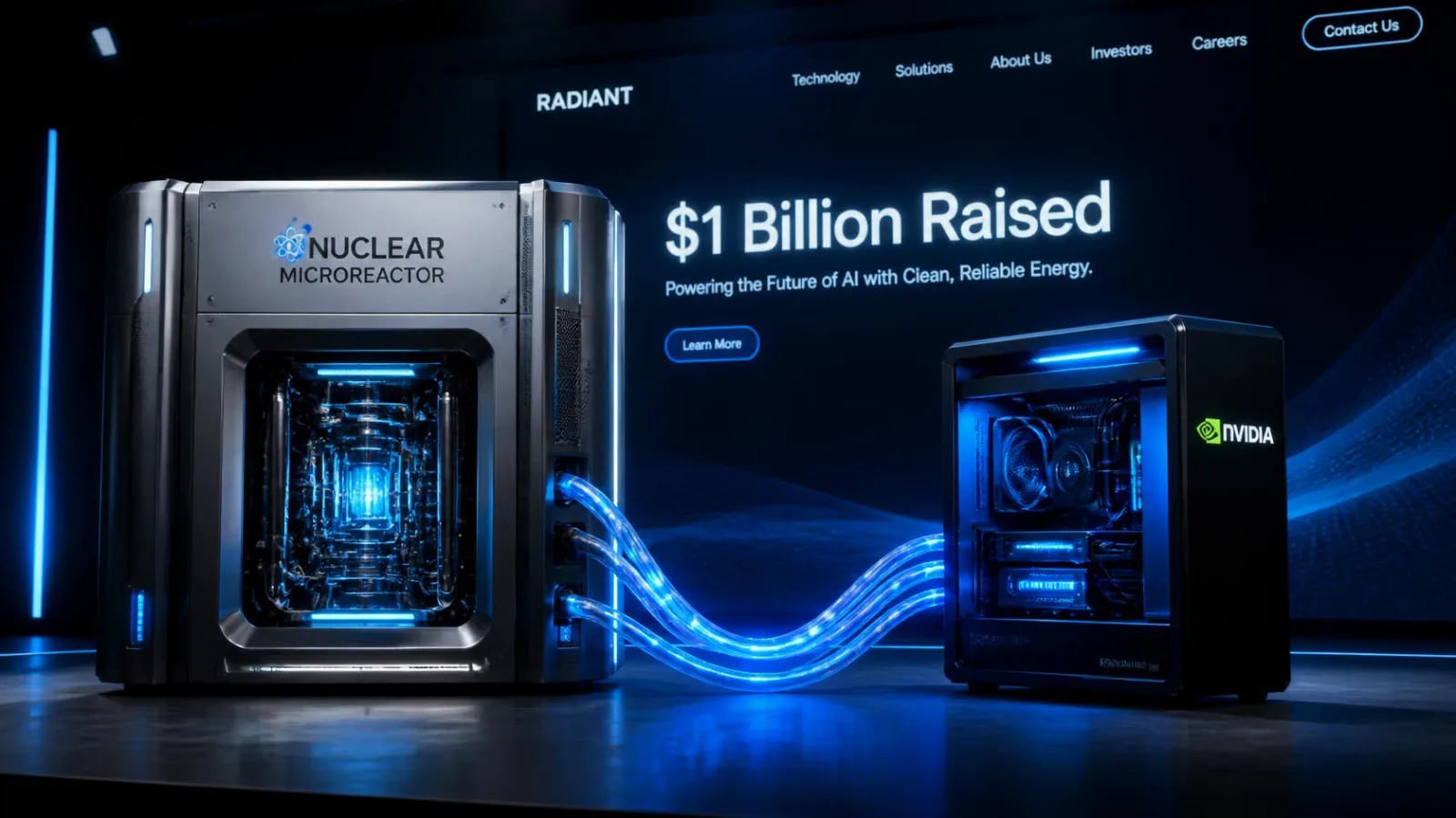
The startup confidently activated their microreactor live on stage. You can read the full technical breakdown detailing how the startup activates nuclear microreactor live on stage. The engineering team connected an Nvidia RTX Spark desktop computer. They plugged it directly into a circuit powered by the reactor.
The reactor safely fissioned uranium atoms in the background. It produced roughly one hundred kilowatts of thermal energy. A specialized thermoelectric generator converted this heat into electricity. Consequently, the reactor successfully booted up the Nvidia system.
Furthermore, they used this exact machine to host a website. Anyone could visit the webpage while the reactor operated. This live demonstration proved their hardware actually works. It silenced many harsh critics instantly. The company effectively merged nuclear physics with modern web hosting.
Building a Waterless AI Factory
The live demonstration was just the beginning. The startup immediately announced a massive strategic partnership. They are officially collaborating with the computing giant Nvidia. Together, they plan to build a completely independent computing facility.
This ambitious project will be a thirty-megawatt artificial intelligence factory. It will operate entirely off the traditional power grid. More importantly, it will not consume any local water resources. This specific detail is incredibly important for future infrastructure. You can review the strategic details explaining how the Valar nuclear startup partners with Nvidia.
The closed-loop design relies entirely on the helium coolant system. The reactor generates power for the heavy computing workloads. Simultaneously, it manages the intense thermal exhaust safely. This innovative setup completely eliminates regional water dependency. Therefore, these advanced factories can be built anywhere. They could operate safely in arid deserts or remote locations. This geographic freedom completely changes the computing infrastructure market. It solves two major environmental crises simultaneously.
Securing a Billion-Dollar Investment
Institutional investors watched these technical milestones very closely. They quickly recognized the massive financial potential. Consequently, Valar Atomics initiated a highly successful funding round. They sought capital to scale up their manufacturing capabilities.
The financial results were truly staggering. The startup successfully secured one billion dollars in Series B equity. Sequoia Capital proudly led this massive investment round. Additionally, the company secured a two hundred million dollar credit facility. You can track the financial market reaction here as Valar Atomics raises $1 billion.
This massive influx of capital raised their overall valuation significantly. Early reports suggest the company is now worth six billion dollars. The CEO outlined a very clear vision for this new capital. They will transition from building single prototypes to mass production. They want to manufacture fleets of identical reactors efficiently. This factory-based approach is crucial for achieving global scale. It dramatically lowers the final cost of nuclear energy.
Overcoming Manufacturing Challenges
Building one working nuclear reactor is a massive achievement. However, manufacturing hundreds of them requires an entirely different strategy. The nuclear industry notoriously struggles with production delays. Every traditional reactor is a custom construction project. Valar Atomics must strictly avoid this historical trap.
Therefore, they are standardizing every single hardware component. They will build the reactors entirely inside controlled factories. Afterward, they will ship the completed units to operational sites. This modular approach ensures strict quality control. It also greatly simplifies regulatory approval processes.
The one billion dollar investment makes this possible. The startup is now aggressively expanding its manufacturing footprint. They are hiring hundreds of top-tier engineers. Moreover, they are securing their own independent fuel supply chains. Taking full control of manufacturing minimizes external logistical delays.
Table Comparison: Traditional vs. Valar Approach
To better understand this shift, we must compare the models. The following table highlights the critical differences. It contrasts traditional data center power with the Valar Atomics approach.
Feature Category | Traditional Data Center | Valar Atomics AI Factory |
Power Source | Regional electrical grid | Dedicated nuclear microreactor |
Water Usage | Millions of gallons locally | Zero local water (closed-loop) |
Construction Time | Dependent on grid upgrades | Rapid modular deployment |
Carbon Emissions | Mixed (depends on local grid) | Zero carbon emissions |
Geographic Location | Restricted to strong grids | Anywhere in the world |
This simple comparison clearly explains the massive investor enthusiasm. The new model solves multiple critical infrastructure problems instantly.
The Impact on Artificial Intelligence Development
This massive abundance of stable energy will accelerate software development. Programmers currently face strict computational limits. However, dedicated nuclear power removes these frustrating barriers. Engineers can train significantly larger and smarter models.
Researchers are currently battling complex software challenges. They are working tirelessly to improve system accuracy. For example, consider the ongoing OpenAI race to eliminate AI hallucinations. Solving these intricate logical problems requires immense processing power. Unlocking grid-independent electricity directly supports these critical safety efforts.
Moreover, reliable computing infrastructure supports everyday consumer technology. We rely heavily on powerful backend servers daily. This includes popular personal devices and modern office tools. For instance, consider the five gadgets that actually earned a permanent spot on my desk. They all require constant cloud connectivity to function properly.
Even modern wearable technology depends on stable server infrastructure. A great example is the smart ring that quietly replaced my smartwatch. These small devices constantly sync sensitive biometric data. They require secure, highly available data centers to process information.
Broader Technological and Financial Implications
The implications extend far beyond just consumer hardware. The global financial technology sector also requires flawless infrastructure. Secure data centers are absolutely essential for managing modern assets. Recent regulatory changes highlight this growing digital need. The landmark SEC crypto ETF approval and regulation perfectly illustrates this trend. Processing thousands of encrypted financial transactions demands reliable, robust power.
Furthermore, dynamic social media trends influence global computing demands constantly. Consumer digital habits can shift incredibly rapidly today. For example, younger demographics frequently change their preferred communication platforms. Currently, Gen Z is ditching Instagram for text-only apps. However, even simple text-based platforms require massive server databases. Every digital interaction eventually traces back to a physical data center.
Nuclear-powered server farms offer a highly sustainable path forward. They provide the necessary horsepower without destroying the local environment. Valar Atomics is pioneering a brilliant hybrid business model. They are simultaneously a nuclear engineering firm and an infrastructure provider. This dual approach gives them incredible leverage in the modern market.
Regulatory Hurdles and Safety Protocols
Despite the incredible engineering success, major challenges still remain. The nuclear industry is heavily regulated worldwide. Valar Atomics must navigate extremely complex legal frameworks carefully. The United States Nuclear Regulatory Commission enforces strict safety guidelines.
However, the Ward 250 features passive safety mechanisms inherently. It uses advanced helium cooling instead of pressurized water. The TRISO fuel particles physically cannot melt under extreme heat. These scientific facts greatly simplify the regulatory approval process. Therefore, government officials are viewing these microreactors very favorably.
The startup actively works alongside federal energy departments. They maintain total transparency regarding their testing procedures and results. This cooperative approach builds essential public trust locally and nationally. Gaining public acceptance is just as important as engineering perfection. Modern nuclear energy is vastly different from older historical designs. Valar Atomics must continuously educate the public about these safety improvements.
The Environmental Impact of Closed-Loop Systems
We must highlight the environmental benefits of this technology again. Traditional data centers consume millions of gallons of water daily. They evaporate clean drinking water simply to cool hot servers. This practice is completely unsustainable in drought-stricken geographical regions.
Valar Atomics completely eliminates this massive environmental burden. Their partnership with Nvidia focuses heavily on water conservation. The proposed thirty-megawatt facility uses a closed-loop helium system. It dissipates heat efficiently without evaporating precious local water supplies.
This technological breakthrough is a massive victory for conservationists. It allows the technology sector to grow without draining aquifers. Furthermore, the reactors produce strictly zero carbon dioxide emissions. They provide incredibly clean energy round the clock safely. Solar and wind power require massive battery storage to operate constantly. Nuclear microreactors provide immediate, reliable baseline power natively. They are the ultimate green energy solution for heavy industry.
A Look Ahead at Nuclear Computing
The technology industry is entering a fascinating new chapter. The days of relying entirely on regional power grids are ending. Massive tech conglomerates need absolute control over their energy supplies. Valar Atomics proved that microreactors are a viable solution.
Their successful live demonstration changed the industrial narrative completely. Powering an Nvidia desktop directly with nuclear energy is historic. It vividly demonstrated the practical reality of their engineering. The subsequent billion-dollar investment confirms the massive market demand.
In a few short years, nuclear AI factories will become common. They will operate silently and efficiently without consuming local water. They will drive the next great leap in human innovation. Valar Atomics took the crucial first step on this path. The future of global computing is undoubtedly nuclear.